Tuesday, August 24, 2010

Featured Artist: Wilma Vissers


A self portrait of Wilma Vissers

Intro

I am Wilma Vissers. I was born in 1962 in the little town of Heerlen in the south of the Netherlands. It's an old mining town. The mines where closed in 1970. I remember seeing big heaps of coal and dust lying everywhere when I grew up. Images of black material and industrial surroundings often come to my mind. I feel these images are important as they were the first impressions of the world around me. Those impressions are still present in my drawings today. I believe the landscape of my childhood triggered my interest in the texture of materials and big monumental forms.

I moved away to study art. First at the art academy in Den Bosch where I studied graphics for a year. I practiced dry needle etching and drawing. I completed my study at the art academy in Groningen where I also studied graphics and painting. Johan van Oord was one the teachers I studied with. He is important to me, as is Ruud de Rode. Johan taught me to experiment with my images and made me aware of the mystery of painting, and Ruud encouraged my way of drawing and showed me that making art can be fun. I graduated in 1989 and I stayed in Groningen because it is a very nice town.

Besides working on my artistic work, I also work as a web designer. I work at a community center where I teach web design to those who want to create their own website.


My bicycle.

I also teach immigrant ladies how to ride a bicycle and how to behave as a road user.


My work

I am inspired by emptiness and space. Spatiality and infinite space must be present even in the smallest work. A particular role is played by my memory of land and seascapes seen in Ireland.


This video is made on St. John's Eve, the 21st of June at midnight. St John's Eve or Oiche Fheile Eoin (Bonfire Night), is celebrated in many parts of Ireland with the lighting of bonfires. (... to learn more about St. Johns Eve visit wiki/stjohnseve )


These visual impressions formed the material I used in the past to make my paintings and drawings. It is often small trivial items, unimportant to other people, that form the basis of my work. I collect images seen in a cursory glance in the street, on the television or as film stills in the paper.


Wilma Vissers, Oil sticks on wood, 2009


While making a work of art, I always ask myself, "how much can be excluded?". My work must express feelings of monumentality and spatiality. There is often a balance between spatiality and two dimensionality resulting from my use of irregular dimensions. For example: long and narrow.


Wilma Vissers, Gouache on sticks, 20x20 cm, 2009


In the last year, I have used actual objects such as a paint spatula, an ice-lolly stick and a large matchstick. By incorporating such unusual materials, the work is charged with lightheartedness and humor, putting the burden of ones relationship with art history into perspective. The round painting is new and lacking corners. Such a form appears to have a stronger relationship with space.


Wilma Vissers, Goauche on wood, wooden knife, 2x7cm, 2008

Wilma Vissers, Oil sticks on wood, 30x15 cm, 2010

Wilma Vissers, Oil sticks on paper

Wilma Vissers, Oil sticks on paper collar, 20 cm, 2008


The works must be thought out spatially; line and color do not stop at the edges but appear to continue beyond. The walls of my studio have a similar function to the walls of an exhibition space and therefore become part of the work. In this way, an overall picture is created which one could describe as a new work of art.


Objects display on the wall in my studio.

Wilma Vissers, Oil sticks on sanding paper, 40x50cm, 2009

Objects installed on the wall in an exhibition space.

Wilma Vissers, Oil paint on wooden shape, 10x20cm, 2007


My latest work is made with oil sticks, wood, paper, carton and sanding paper. My work often arises from objects other artist friends give me. For example, an interior designer that I know has very nice samples of wood. These wooden blocks have a very nice surface or a very interesting grain and nice coloring. Every piece of wood has a different internal character which I can accentuate by applying oil stick color to them. Sometimes a little dab of a certain color is enough and large parts of the wooden surface will remain open and untouched.


Wilma Vissers, Oil paint on wood, 2008

Wilma Vissers, Oil paint on wood, 3x5 cm, 2008


Within the the last two years I made a drawing every day in a Moleskine sketchbook. The drawings are small and made with a black pencil. I take the pencil in my hand and go wherever the pencil takes me. The drawings reflect my mood and events that happen to me and my ideas and thoughts appear in it. It is more spontaneous and direct than my other artworks because of the technique of drawing. In a way it is like a diary with drawings. I put the drawing of the day on my website and on Facebook.


Wilma Vissers, everyday drawing made in a sketch book with black pencil, 2010

Wilma Vissers, Everyday drawing made in a sketch book with black pencil, 2010

Wilma Vissers, Everyday drawing made in a sketch book with black pencil, 2010


This Spring, I stayed in an international art center in the county Donegal in Ireland called Cló. This art center is an artist-lead initiative that provides a platform for creative exchange between international artists and the Gaeltacht community in Ireland. I had a very nice stay there and I was very productive. I was very much inspired by the landscape and people of Ireland.


I stayed in room this during my residency at Cló in Ireland.

This is Cló's front garden.

A television set left behind on the roadside on a beautiful Ireland landscape.

This is a wall of a house standing in the valley of Glenlough in Donegal Ireland.


I took a graphics workshop during my residency at Cló. My aim was to take some drawings out of my Moleskine sketchbook and make lithographs out of them. In that way the images from the book could evolve a little bit further and they are freed from the sketch book.


My daily drawing in Moleskine sketchbook.


By creating lithography out of my everyday drawings, I developed the images that came from drawings little bit more. The technique of lithography was very suitable for this. I will show these lithographs in my studio in Groningen in November.


Lithography made during my residency at Cló in Ireland, 40 x20 cm, 2010

Lithography made made during my residency at Cló in Ireland, 19 x12 cm, 2010


Exhibitions

I will be showing my work with two other artists, Ahn Hyun-Ju and Eric Knoote at ParisCONCRET in Paris, France this September. This exhibition, Position Fludium, will be opened from 4 September - 25 September, 2010.


Wilma Vissers, Oil sticks on wood, 40x20cm, 2010


G
allery hours are 2-5pm, from Wednesday to Saturday. You’re cordially invited to an opening reception with the artists that has been scheduled for Saturday, September 4 at 5-8pm. ParisCONCRET is located at 5 rue des Immeubles Industriels in Paris. Please visit its website for more information.


Contact


Wilma Vissers, Oil sticks on wood, 10x15cm, 2008


Am I available for commissioned works? It depends on the kind of commission. I designed the cover of the Ambrozijn for a year. This is an art and literature magazine from Flanders in Belgium.


One of Wilma Vissers' cover designs for the Ambrozijn, art and literature magazine Flanders in Belgium


M
y artworks can be seen at www.wilmavissers.com. Your readers are welcome to contact me at wilma.vissers@home.nl

...............................................................................................
Image Credit: All images courtesy of Wilma Vissers.

Monday, August 16, 2010

Featured Artist: Gerd Jansen


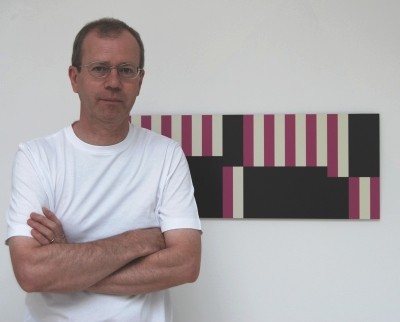
Gerd Jansen, in front of a countune-picture, 2010.


A brief intro

I was born in Goch in 1956, a little town not far away from Düsseldorf, Germany. As a pupil I was interested in Art, Music and Science. When I was 17 the very first art project I created was an illustration based on the musical works of Frédéric Chopin. I was interested in finding a method for the composition of drawings, paintings and graphics. I followed this pursuit for many years until I found the method in 1997.

I first studied physics in Göttingen University in the east of Germany. After finishing my schooling in 1975, the art calling had become stronger and in 1978 decided to pursue art. I studied sculpture and drawing with Professor Tony Cragg and Professor Erwin Heerich in Düsseldorf, who was a very close friend of Joseph Beuys.

Professor Heerich gave me very strict, but valuable advice that enabled me to express my unique idea of art. Because I was half scientist and half artist, many of my works looked like scientific graphics during that period. In 1986, I lived in Paris for many months, and there I found the most important part of my temperament, and that was to work in serial processes. This working method was successfully created when I discovered the Natural Numbers as my real composition system in 1997.

For a decade or so, I have created many series using this compositional system. In 2009, I founded the "International Social Art Project" called countune, which includes all my ideas and experiences that have accumulated over the past 35 years of art making. I apologize for these titles; they are difficult to translate.

The below, is an image-overview of nine periods within the past 35 years of my art making:


1- Gerd Jansen, Musik im Bild? (1975-1980)


2 - Gerd Jansen, Gedankenmodelle (1981/82)


3 - Gerd Jansen, Ein Experiment zur Ganzheit (1983/84)


4 - Gerd Jansen, Das Weltall als Idee 1985


5 - Gerd Jansen, Die Komplementarität von Feld und Gestalt (1986)


6 - Gerd Jansen, Das Prinzip der Wiederholung (1988 - 1990)


7 - Gerd Jansen, Thema und Variation (1991 - 1996)


8 - Gerd Jansen, Bilder als Musik: Zahlen (1997 - 2008)


9 - Gerd Jansen, countune (since 2009)


In the year 2000, I founded the Institute for Visual Thought (Institut für bildnerisches Denken), an art venue for exhibitions and music performances with my wife, pianist Christine Jansen. In the nine years since its establishment, we have successfully presented 30 exhibitions of wonderful work by artist friends as well as my own work. Pianists from around the world had performed more than 100 concerts at the Institute.


Installation by Gerd Jansen at the Institute for Visual Thought, Ouvertüre op.39,02, paper, string and nails.


In 2009, the Institute moved into its new phase, and is now completely integrated into an interactive online art project called the countune. To learn more about countune, please visit website


About my work:

My work is the result of the core method of composition I developed as a pupil. It was nearly a scientific strategy to develop this idea. The system of the Natural Numbers, including the important Prime Numbers, allows me to make very different works in appearance, but which all show the same basic idea.

I do not specialize in a specific material, but when I decide on a material, I try to transfer the specific material aspect in the work. My thinking and my strategy is always 3-dimensional. Another important aspect of my process is that I always work in series. No work is created as a single stand alone piece. If a collector prefers, he/she is welcome to purchase a single piece of art work.

I would like to give an example here:

In my Rhapsodie op.94,06 (one from an 8 piece series) there are two fields, a free one ( it's a collage with two different papers) and the more systematic field: the vertical lines with one horizontal line. Now I start to count the intervals, first the intervals above and then the intervals below the horizontal line. The start number can be any number, but the number I choose decides the picture structure. If there is a Prime Number in the counting process, the interval gets a painting. So you can say that the Prime Numbers, in combination with the first number, provide the structure of the composition. This has been the case in all my work since 1997.


Gerd Jansen, Rhapsodie op.94,06, collage, drawing, painting, 21x21 cm


Compare the Rhapsodie op.94,06 with the next picture, an Industry-Building I made in 2008. The system is absolutely the same as in the Rhapsody. The intervals here are black and white on large (1m x 6m) metal panels.


Gerd Jansen, Industry building, metal panels, 100x20x12 m, 2008

The next example is a piece from the Lieder op.14 (one from 15 pieces). Here again we have a free collage field and on it I draw squares at regular intervals. The counting process starts in the middle of the piece and continues spirally to the outside.


Gerd Jansen, Lied op.17,04, collage, drawing, painting, 21x21 cm

In the Prélude collé op.19.11, the free collage field is more regular and the square field is a little bigger. So you can see how I change the parameter to get different results.


Gerd Jansen, Prélude collé op.19,11, collage, drawing, painting, 21x21 cm


My experience with the Institute and the international art scene gave me the idea to launch the "International Social Art Project", countune www.countune.com in 2009. I have been creating pictures with artists from many countries on this virtual platform since it was initiated one year ago.

Now countune is a registered Trademark. Here are some of the basic ideas behind countune:

It is a new concept for exhibiting pictorial art. Its significance is rooted in an on-going graphic representation of the sequence of natural numbers.

countune demonstrates a structural form inherent in the sequence of numbers. In this regard, it is possible to speculate that numbers could be constituent criteria of our universe.

countune is in fact based on the sequence of natural numbers, although in the process of creating pictures it makes use of one further precept. All the resulting images become progressively interrelated and so help to form a community of owners who can all be found somewhere along the number line with their own "plot of numbers".

countune's idea is to give the viewers their own range of numbers so that each picture contains the individual's quite specific freedom of choice; as result a barrier is then lifted. On the website’s "join in" page, the viewer can decide the quantity of numbers (the length of the picture) and the colors for his picture.

countune is a combination of two verbs, "to count" and "to tune", and thus signifies the fusion of horizontal and vertical movement and to some extent comparable to the melody of a song. This movement is the result of the constant repetition of a single entity based, in principle, on a number line with a perpendicular wave. The arbitrary distribution of prime numbers gives the resulting area its structure.

At the moment, I'm working hard on a completely new website which functions automatically. Here is an example: Numbers 15630 – 15645, a picture made by Robert Novel.


countune-picture #15630-15645, cooperation from countune and Robert Novel.
Original graphic size 10x16 cm. It is could be an example of a possible wall sized painting.


I have completely stopped working with traditional art making processes since 2009. I now primarily work with my computer on the countune-project. My earlier works are mostly in private collections, but many of my recent works are in the permanent collections of the Moyland Castle Museum, Museum Kurhaus Kleve and Museum Goch in Germany.


Contact:


Gerd Jansen
Bergstraße 11,
79639 Grenzach-Wyhlen,
Germany
0049(0)7624-989460
info@gerd-jansen.de

Websites:
www.gerd-jansen.de
www.countune.com
www.institut-fuer-bildnerisches-denken.de


...............................................................................................
Image Credit: All images courtesy of Gerd Jansen.