
First of all, please introduce yourself to our readers that might not be familiar with you and your work.

Featured artist Mary Bucci McCoy. Photo: David McCoy
My name is Mary Bucci McCoy. I was born in New Brunswick, New Jersey. When I was three we moved to the Philadelphia area, which is where I grew up.
Making art has been a part of my life for as long as I can remember: I was conscious of it as a significant activity from an early age. My parents supported me in that, and I began taking classes outside of school from practicing professional artists when I was seven. When I was twelve I had surgery followed by a ten month recovery and couldn’t take art classes during that time. Having made it through that I wanted to try something new so took a ceramics course taught by Philadelphia artist Syd Carpenter. I fell in love with the medium.
I feel fortunate to have grown up near the Philadelphia Museum of Art. When I was first exploring figure drawing I was looking a lot at the Arensberg Collection of modern art, especially Duchamp and Brancusi. It was a deeply formative experience for me.
I came to the Boston area in 1980 for the 5-year, two degree program at Tufts University and the School of the Museum of Fine Arts. I earned a BA in English and a BFA. The Museum School doesn’t have official majors or concentrations, but my main focus there was ceramic sculpture.
When I graduated I was awarded the Alice Pratt Memorial Traveling Scholarship from the Museum School ceramics department. This enabled me to spend a sixth, post-bac year studying ceramic sculpture, at l’École Superieure d’Arts Appliqués in Geneva, Switzerland with colleagues of one of my Museum School teachers. My work there involved documenting the ways human interaction with the built and natural environment were delineated through signs and marks, and distilling that understanding of place into abstract forms. The underlying question I was working with was “how do we know where we are?” or “how do we locate ourselves?” It was a challenge to present and defend my work in French throughout that year, in the context of a different culture and educational system, and especially when my final review panel included the director of the Musée d'art et d'histoire (Museum of Art and History).
After my year abroad I returned to the Boston area and settled in Somerville, which at the time had affodable apartments and studio space. I lived and had my studio there for 13 years. During that time it became a very desirable and much less affordable place to live, and so in 2001 my husband David McCoy and I moved to Beverly, on the coast north of Boston, to have the living and studio space we need. We are a ten minute walk from the ocean. Being situated on the coast, with the ocean and the rugged landscape of nearby Cape Ann has certainly influenced my art.

Mary Bucci McCoy, Nothing But, 8 x 8 x 3", acrylic and graphite
on plywood panel, 2009. Photo: Mary Bucci McCoy
While I guess you could say that on some level I have always known I was an artist, I have not always known I was a painter. I began moving from working with clay as my primary means of investigation to paint a few years out of art school. It took me a long time to find my way as a painter, not least of all because as I began painting I realized that I had no interest whatsoever in canvas or brushes. But that did give me the freedom to find other ways of working with paint. Beginning with abstracted landscape painting I moved through painted wall constructions to minimal paintings on bare Medium-density fiberboard (MDF) panels to my current work.

Mary Bucci McCoy, If , 8 x 8 x 3.25", acrylic and graphite
on plywood panel, 2009. Photo: Mary Bucci McCoy
Currently, what type of job(s) you do besides making art? Do you teach, write and/or curate art exhibits?
Besides making art, I do graphic design and teach one graphic design course at Montserrat College of Art in Beverly each semester. The design work functions as a counterbalance to painting that makes me acutely aware of the opportunities that painting offers: design is explicitly language-driven, in that you are always working to meet the verbally-expressed criteria of a client. And most of my design work is on the computer. My studio and design office are both in my home, so it is very easy to balance studio and design work. It is a very positive arrangement for my artwork.
I have also written reviews for Art New England Magazine for the past ten years covering work by local and regional artists as well as internationally known artists such as Donald Judd, Jessica Stockholder, and Pat Steir. Besides the obvious function of serving my professional community, writing about art makes me stop and really think through my reaction to and understanding of the work. I try to understand the experience the artist has in making their work. That engagement helps me to be that much more focused in my own studio work, and also gives me that much more perspective on my own work.
Please tell us a bit about your work in general. What media do you work in? What are the inspirations behind the creation of your paintings? What is the specific message you strive to convey to your viewers? Would you like to discuss a bit your creative process?

Mary Bucci McCoy, Sweet Spot, 8 x 8 x 3", acrylic and graphite on plywood panel, 2009
Photo: Joe Ofria
I work in acrylic on two kinds of wood panels. One type is about 3” deep, with the wood exposed on the sides of the panel; I craft those panels myself. The other kind is about half as deep, and the painted ground covers the front and sides completely. For me these are very different spaces to work in, yet they share the implicitness of the frame.

Mary at work in her studio. Photo: David McCoy
I also work on Japanese kozo paper, and experience paper as yet another kind of space. When I am working on the panels, I am working on the surface. Whereas the paper is a receptive substrate, and I can work it from both the front and back.

Mary Bucci McCoy, see through, 12 x 17", acrylic on kozo paper, 2009
Photo: Mary Bucci McCoy

Mary Bucci McCoy, about, 12 x 17", acrylic on kozo paper, 2009
Photo: Mary Bucci McCoy

Mary Bucci McCoy, over all, 12 x 17", acrylic on Okawara paper, 2009
Photo: Mary Bucci McCoy
I use painting as a means to obliquely explore human presence, identity and connection both within the paintings through an abstract language of marks, and between the viewer and the paintings. The marks articulate and activate the intermediary spaces of relationships: figure/ground, organic/geometric, fluid/static, connection/isolation, 2-d/3-d, emotional/physical.

Mary Bucci McCoy, Glimmer, 16 x 16 x 3", acrylic and graphite on plywood panel, 2009
photo: Mary Bucci McCoy

Mary Bucci McCoy, Since, 8 x 8 x 3", acrylic and graphite on plywood panel, 2009
Photo: Mary Bucci McCoy
I am much more interested in intimacy than spectacle. I want the work to draw the viewer in. And I want it to be necessary for the viewer to be there, to be physically present with the work to truly experience it. It is work that cannot be reduced to a single image. It is work that I hope people can have an ongoing, non-verbal dialogue with over time.

Mary Bucci McCoy, So Close, 16 x 16 x 3", acrylic on plywood panel, 2008
Photo: Mary Bucci McCoy

Mary Bucci McCoy, Sleeper, 16 x 16 x 3", acrylic on plywood panel, 2010
Photo: Mary Bucci McCoy
My early work with clay is very much an influence in my approach to painting. It affects the way I handle paint and the way I experience painting, and also the sense of craft I bring to my work. When I was studying ceramics in Boston and Geneva, I looked at a lot of work — ceramics, sculpture, painting, prints, installations — by European, Japanese and west coast artists, much more so than work by New York artists. I visit New York frequently now, but I remain equally interested in and influenced by art from other places and cultures. And art from other times: I have been finding lately that I really connect to some ancient artifacts. One of the most powerful pieces I have seen recently was a lidded ceramic burial urn in the “Arts of Ancient Vietnam” exhibit at the Asia Society in New York this past spring.
Are you currently showing your work? If yes, when and where, what's title of the show, what can the viewers expect to see in this exhibit?

Mary Bucci McCoy, Trace, 8 x 8 x 3.5", acrylic on plywood panel, 2010
Photo: Mary Bucci McCoy

Installation view, Mary Bucci McCoy: Trace at Kingston Gallery
Photo: Mary Bucci McCoy
Mary Bucci McCoy: Trace is on view in the back gallery space at Kingston Gallery, 450 Harrison Avenue in Boston South End through January 2, 2011. It’s a closely focused exhibit of two new paintings and three works on paper in an intimate space. Not only is the work in this exhibit new, but four of the five pieces each represent the start of a new series of works.

Mary Bucci McCoy, Verge, 24 x 24 x 1.5", acrylic on panel, 2010
Photo: Mary Bucci McCoy
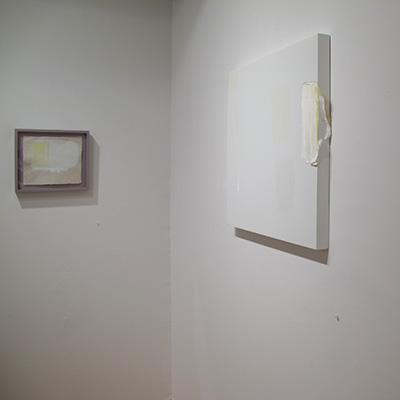
Installation view, Mary Bucci McCoy: Trace at Kingston Gallery
Photo: Mary Bucci McCoy

Mary Bucci McCoy, up, away, 9.5 x 10.75", acrylic on kozo paper, 2010
Photo: Mary Bucci McCoy
Are you planning any exhibitions of your work in the near future?
I will have one piece (Wish) in a group show called “Dialogues” at Kingston Gallery in January 2011. The next solo show I have scheduled will be at Kingston Gallery in March of 2012.

Mary Bucci McCoy, Wish, 16 x 16 x 3", acrylic on plywood panel, 2010
Photo: Mary Bucci McCoy

Mary Bucci McCoy, Wish (detail), 16 x 16 x 3", acrylic on plywood panel, 2010
Photo: Mary Bucci McCoy
Would you like to share your contact info with our readers? Do you have website(s) for interested readers to learn more about your work? Representing gallery if any?
I invite people to visit my web site, www.buccimccoy.com. I can be reached by email at mary@buccimccoy.com. I am represented by Kingston Gallery in Boston, Massachusetts.

Mary Bucci McCoy, Of, 16 x 16 x 3", acrylic on plywood panel, 2009
photo: Mary Bucci McCoy

Mary Bucci McCoy, Of (detail), 16 x 16 x 3", acrylic on plywood panel, 2009
photo: Mary Bucci McCoy
Finally, is there anything else you would like to say about your work?
Three interrelated questions that people frequently ask me are “Do you know what the painting is going to be when you start?” and “How long does it take you to make a painting?” and “How do you know when a painting is finished?” All I know when I begin a painting is the color of the ground, which I choose because I have questions about what could happen in the space of that color.

Mary Bucci McCoy, Lost, Found, 8 x 8 x 3", acrylic and graphite
on plywood panel, 2009 (Private collection). Photo: Mary Bucci McCoy
My painting process is punctuated by long pauses, as marks “sink in” and the next step becomes clear. And I may not be able to figure out the next step with one painting until I take a step with another painting, so there is in a sense a dialogue between the work as it develops. Sometimes it takes months. It is a process of finding out, and I am always happy when work surprises me with the direction it takes, and especially if it takes me somewhere no other media could. The act of painting is profoundly, continually compelling for me.

Mary Bucci McCoy, At Once, 8 x 8 x 3", acrylic and graphite
on plywood panel, 2009. Photo: Mary Bucci McCoy

Mary Bucci McCoy, At Once (detail), 8 x 8 x 3", acrylic and graphite
on plywood panel, 2009. Photo: Mary Bucci McCoy
...................................................................................................


