Wednesday, November 23, 2011

Featured Artist: Brian Corey

..................................................................................

First of all, please introduce yourself to our readers that might not be familiar with you and your work.


Featured artist Brian Corey

My name is Brian Corey. I currently reside in Medford, MA with my wife and two children. I grew up 40 minutes north of Boston in the town of Chelmsford. Drawing became an active interest at an early age, my parents were supportive of my creative endeavors and enrolled me in various art making and drawing courses. I was very lucky to attend a high school that had a strong visual art department and fostered my pursuit of various art making processes. I knew in high school that I wanted to attend art-college with the original intention of becoming and illustrator or graphic designer. After sampling a couple of colleges I earned a BFA in art education/painting from the Massachusetts College of Art and Design in 1995, and in 2007 I completed my MS in Art Education also from Mass Art.


Currently, what type of job(s) you do besides making art?


Right after completing my undergrad I began teaching visual art in various public school settings. For the past six years it is my pleasure to be an art instructor at the Ottoson Middle School in the town of Arlington. My main responsibility is to develop and implement a curriculum that exposes students to various contemporary artists, concepts, and art making experiences while exploring the mediums drawing, painting, printmaking, and sculpture. In addition to teaching, I am also responsible for creating and managing the art department website, serving on various school committees, and coordinating an after-school art class.


Can you give our readers some insight into your work in general?


Brian Corey, Untitled 4, 8" x 8", Acrylic and Ink on Panel, 2011


I work in the medium of drawing and painting. My work is a series of lines layered on a panel in a manor that resembles abstract mapping or topography. The process of layering intentional and random lines mimics the growth and decay that occurs in terrain.


Brian Corey, Untitled 3, 8" x 16", Acrylic and Ink on Panel, 2011


Brian Corey, NE Boundary, 24" x 24", Acrylic and Ink on Panel, 2011.


I am most attracted to the ambiguous forms that emerge, multiply, breakdown, and flourish anew. Although my work is heavily influenced by landscape and the natural world that inhabit the landscape, I am not trying to create a specific representation of those objects, but invent a history of a place.


Brian Corey, Untitled 1, 16" x 16", Acrylic and Ink on Panel, 2011


Brian Corey, Untitled 2, 16" x 16", Acrylic and Ink on Panel, 2011


Would you like to share a bit your creative process with our readers?


Brian at work.

I draw/paint on paper or panel. I thin out ink and acrylic paint as much as possible. Then I begin creating a series of lines on the surface of the panel with a number 1 or number 2 paint-brush.


After I have created a layer, I cover the layer with a thin coat of paint, and repeat the whole process over and over. I will try and save some areas of the painting or delete other parts, it is a very intuitive process. It is time consuming and often tedious so I work in small chunks of time.


I have not had a studio for about three years and actually use my classroom as my studio. It works for me I can work a little here or there, after school, or during a free period if I have one.


Do you have plans for your direction?
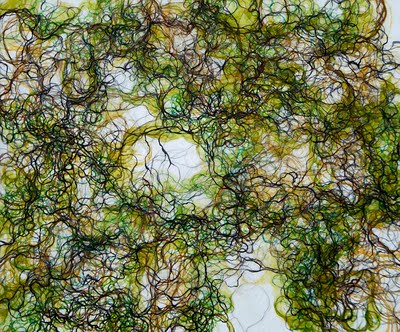


Brian Corey, Untitled, 10" x 12", acrylic and ink on vellum, 2010

Right now the only plans I have in the direction category, is to change the scale of my work. For the past few years the work I have been making has been no larger than sixteen inches by sixteen inches. I think it would be very interesting to see these drawings made on a larger scale such as twenty five inches by twenty five inches or larger.


What is the most interesting comment about your work you have heard from a viewer?


Brian Corey, Specimen area A, Acrylic and Ink on Paper, 2008


“It looks like hair in the drain.”


How have you handled the business side of being an artist?

This is a difficult question to answer, because I feel like I am still learning the “business” of art. I ask a lot of questions and advice from friends and colleagues. I stay in touch with the network I am developing. It has been my experience that opportunities present themselves in unexpected places, so I try and put myself out there as much as possible.


How many years have you been an artist member of Kingston Gallery? What had inspired you to join this artists cooperative gallery?


Kingston Gallery is located at 450 Harrison Avenue #43, Boston, MA 02118.
Please visit website to learn more about how to becoming a member artist.


I have been a member of the Kingston Gallery for the past 3 years. I had just finished my graduate degree and I was looking for way to become more involved in the art community than I had been. The Kingston was looking for new membership and I applied and was accepted. The Kingston Gallery is made up of a wonderful group of artists at various points of their art careers. It is a pleasure to be a member of the Kingston community, the value of having access to so much experience is amazing.

Please tell us a bit about your duties as a member of this artist-cooperative gallery.

My duties as a member have ranged from preparing the space for exhibition, helping hang and promote exhibitions, coordinate a mailing list with other members, participate in the financial team, and sit at the gallery.


What galleries have you recently exhibited in?


In the past year I have exhibited in the Bannister Gallery at Rhode Island College. I participated in the member’s exhibit at the Kingston Gallery.
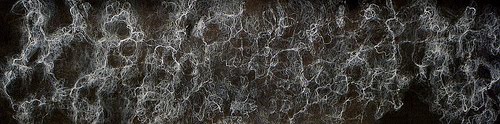


Brian Corey, Area 14, 13" x 36", Acylic and Ink on Paper, 2009


Brian Corey, Land Here, 13" x 26.5", Acrylic and Ink on Paper, 2009


Installation view.


I recently had the wonderful opportunity of participating in a “Pop-Up” exhibit called Gobs of Lines Some Wet Some Dry.


Brian Corey, NE BOUNDARY, 24" × 24", acrylic, ink and graphite on panel, 2011


This show was curated and hung by a local artist named Conley Harris, who opened his own studio to the public to host this exhibition. I very much enjoyed being a part of this exhibition. I had the opportunity to hang my work along side artists I really admire such as Mary O’Malley, John Guthrie, and Chris Faust. It would be great to see more of these spontaneous exhibits in this area.


Would you like to inform our readers of your current and upcoming exhibits?


Installation view: Brian's work at Oficio.


Brian Corey, Untitled, 8" x 8", Acrylic and Ink on Panel, 2011

I currently have a body of work on exhibit at a boutique office space called Oficio on Newbury St. This show will be up through January 13, 2012. Other artists participating in this exhibit are Sand T Kalloch, Nikki Rosato, and Shireen Agah Yadollapour. I will have a solo exhibition of my work at the Kingston Gallery in July of 2012.


Please share with us the awards and recognition you received in the recent years.


Brian with his work.

In 2008 I won a painting Fellowship Award from the Massachusetts Cultural Council. Please Click here to go to MCC Award Page.

Are you available for commissioned works? Do you have website for interested readers to learn more about your work?

I am available for commissions. Please visit my website www.briancoreystudio.com for more information and images of my work.


..........................................................................

Tuesday, November 1, 2011

Featured Artist/Gallerist: Robert Walden

.....................................................................................

First of all, please introduce yourself to our readers that might not be familiar with you and your work.


Featured artist/gallerist Robert Walden.


My name is Robert Walden and I was born in Georgia (USA) and grew up in Mississippi. I began my official training at the university where my father taught painting, drawing and printmaking and finished my BFA, in painting and printmaking at The Atlanta College of Art (ACA). However, growing up in my father's studio was the actual beginning of my life as an artist. I currently live and work in Brooklyn, New York.


Can you give our readers some insight into your work in general? What media do you work in? What are the inspirations behind the creation of your work? What is the specific message you would like to convey to your viewers?

My Ontological Road Maps are ink on paper maps of fictional places. They begin as any city or organism would at the dense center and grow outward in all directions. I do not feel inspired to create my work… it is a feeling more like being compelled. Since I was a child I have been intrigued by maps and mapping. One of the interesting aspects of using maps is that from primary societies to advanced ones like our own, whether a person is scratching in the sand or clicking images in Google Earth all humans understand the idea of mapping. This is very possible one of the few universal experiences of humanity. Therefore, my work is accessible to many people… it is a convenient entree into the work. On first encounter most viewers project an identity on my drawings… most say a particular drawing is Paris or London or other city. This process of applying an identity, something familiar to an object or image that is unfamiliar is intrinsically human. I do not seek to project a specific meaning in my work… that type of work is what I call, "I get it art." Instead I hope my work is layered and abstract enough that it allows the viewer to extract multiple meanings.


Robert Walden, Ontological Road Map 121410, 30" x 30", Ink on paper, 2011
Photo credit: Nick Ghiz


Robert Walden, Ontological Road Map 123110, 30" x 30", Ink on paper, 2011
Photo credit: Nick Ghiz


My Ontological Surveillance Maps are a take on the ORMs... but consist of two panels, one is a map the other is a detail of the map that has been enlarged in Photoshop and projected onto a second panel and then painted to match the ink of the drawing.


Robert Walden, Ontological Surveillance Map 031403, 24" x 36", Ink and acrylic on panel, 2003. Photo credit: Nick Ghiz

The statement about my work on my website is a pretty good explanation of the ideas in my work that I am most interested in highlighting.


Would you like to share a bit your creative process with our readers? How does it all start, what techniques and materials do you use?


My Studio Table with a new series in progress using mechanical pencil and gouache.
Photo credit: Henry Chung


Like mentioned earlier, my drawings begin in the dense grid areas and grow out from their like any real city of organism would. They are all made by hand… no computers involved. However, for the dense areas… now that I have to wear reading glasses I also use a magnifying glass. I use several different pens in my work Pigma Micron is a favorite (size 005 or .2mm) and also pens by Uniball and others… some of my which I found on trips to Hong Kong… the smallest of which has a tip of .18mm.


What is the most interesting comment about your work you have heard from a viewer?

This is difficult to answer. I have had numerous interesting conversations about my work and they have been very rewarding... but, to pick one above the rest in near impossible. I remember the most common questions because I have answered them most often and I remember the most annoying questions. However, the single most intriguing questions have been about my use of fractals... which, when first asked about them I could not define what one actually is. Now that I can define what a fractal is, I can safely say my work has nothing to do with them... however, it is very interesting that some people make the association. The single most annoying question is when someone asks me, "Is this a map?"


Robert Walden, Ontological Road Map 110810, 30" x 30", Ink on paper, 2011
Photo credit: Nick Ghiz


Robert Walden, Ontological Road Map 110810 (Detail), 30" x 30", Ink on paper, 2011
Photo credit: Robert Walden


How have you handled the business side of being an artist?

This is the most difficult aspect of being an artist. It is also the part of an artist's career that an art degree prepares an artist the least. This is a major failing of institutions and something most artists like to ignore… but it is just as important. My guiding rule is not to be a temperamental artist and understand that the gallery is not the studio. Also, I think artists are today leaving too much about their careers and the market in general to others. In NYC artists often wax poetic about the good old days of the East Village and SoHo before that. Well, those good times didn't just happen by accident. Artists made that happen and we need to do that again. We artists, especially the young MFAs, need to quit expecting a gallerist to hand us a career. Artists need to learn how to be better business people without letting their work suffer. It is a difficult task… but a balancing act we must do.


What galleries have you recently exhibited in?

Recent exhibitions include groups exhibitions at Muriel Guepin Gallery, Brooklyn and Exhibit 23 in Valley Cottage, New York and The Berardo Collection Museum of Modern and Contemporary Art in Lisbon, Portugal.


Robert Walden, Ontological Road Map 010811, 30" x 30", Ink on paper, 2011
Photo credit: Nick Ghiz


Would you like to inform our readers of your current (or upcoming) exhibition(s)?

Upcoming exhibitions include: The Art of Mapping curated by TAG Fine Arts in London, November 14-26, 2011, and next year, The Map as Art at the Kemper Museum of Contemporary Art in Kansas City, MO, September 14, 2012 - January 13, 2013.


Robert Walden, Ontological Road Map 010711, 30" x 30", Ink on paper, 2011
Photo credit: Nick Ghiz


What are you working on right now?


I am working on two new bodies of work, but I am not prepared for anyone to see images of either series at this point... but I can say that one series is based on my Ontological Road Maps and the other is an entirely new series of fictional urban spaces and I am using mechanical pencil and gouache on those... check my website occasionally for images of new work.


Please share with us the awards and recognition you received in the recent years.

I was the recipient of a grand from The Pollock-Krasner Foundation in 2003 and a resident artist at the Edward Albee Foundation in 2005.


Do you offer any art classes? Are you available for commissioned works? Do you have website for interested readers to learn more about your work? May our readers contact you?

No, I do not offer art classes but I will consider commissions. My website is located at www.robertjwaldenjr.com. I can be contacted through my website contact page.


Currently, what type of job(s) you do besides making art? Do you teach, write and/or curate art exhibits? If so, give us some details?

My partner Henry Chung and I own and operate RHV Fine Art a commercial art gallery featuring the work of emerging and mid-career artists. (RHV is located at 683 6th Avenue in Brooklyn, New York City.)


You're a talented artist as well as a gallerist. Could you tell us a bit about your gallery RHV Fine Art? What inspired you and your partner Henry Chung to establish RHV Fine Art? When it was established, where it's located and how is it being operated?

First, thanks for the kind words. And to answer your question... we founded RHV Fine Art as part of Robert Henry Vintage in the summer of 2008, which was a late Modern (1950s-1985) vintage housewares store located in the southern end of Park Slope or The South Slope or Greenwood Heights, depending on which real estate developer you ask. We started showing our own work and work of friends on the walls of the store. But because of several factors, the economy and our location to name two, we migrated to showing art only because we could and did start showing in art fairs. This meant we were not dependent on our location for our market and basically we could show in different locations around the country and essentially bring our artists to a market. We migrated Robert Henry Vintage to an on-line store only and utilized our storefront as art exhibitions space only.


What are your goals for RHV Fine Art?

Our goals are first and foremost to show great art but we would like to find a balance between showing and selling art and making it in our own studios... and, and this is the difficult part, actually, reaping a financial reward also.


What do you do on a daily basis running RHV Fine Art?

Everything from sweeping and cleaning to making and maintaining contacts with clients, curators, consultants, etc., writing press releases, arranging shipping, curating our exhibitions, studio visits with artists, dealing with art fairs... basically everything a gallerist does.


What has been the most rewarding experience you've had as a result of running RHV Fine Art?

That would probably be the conversations about the work... we find it particularly disappointing when we do not have interesting conversations (especially at an art fair) about the work. It is about the ideas of the work after all... art consists of three aspects: the object (or lack thereof), the process of making it and the viewing of it or the experience of it... without these three elements... I don't know what it is...


Would you provide links to articles and reviews about your gallery work?

Here is the Press page from our website which has our English language reviews to date: RHV Fine Art Press.

Lucio Pozzi wrote a review of James Clark's The Luminiferous Aether in Il Giornale dell'Arte... in Italian.


......................................................................................