
............................................................................................
First of all, please introduce yourself to our readers that might not be familiar with you and your work.

Featured artist Nikki Rosato
My name is Nikki Rosato, and I am currently a MFA candidate at the School of the Museum of Fine Arts, Boston. I grew up in a small town in Pennsylvania called Washington Crossing (the exact location where George Washington crossed the Delaware River and fought the famous triumphant battle against the Hessians in 1776.)
I didn’t take my first official art class until my senior year of high school, and it changed my life—I started developing skills as well as a passion for creating.
I went to college the next year at the University of Pittsburgh, not knowing what I wanted to study. My hunger for the arts continued to grow, and I ended up declaring a Studio Arts major my first year. I spent the next four years studying Studio Arts and Art History, and it was there that found what I was meant to do in life. I took classes across the board, from sculpture to graphic design, and I learned how to develop conceptual ideas through multiple mediums.
After graduating in 2008, I spent a few years working at an amazing contemporary art museum in Pittsburgh called the Mattress Factory, and in 2010 I was accepted into the graduate program at the School of the Museum of fine Arts affiliated with Tufts University in Massachusetts.
Currently, what type of job(s) you do besides making art?
I’ve spent a lot of time working and volunteering in art institutions and museums. As an artist, I find art museums to be extremely stimulating environments. Not only is it important to know what your contemporary artist peers are making and exhibiting, but being involved at an art museum allows you to continue your art education beyond academia. It also helps keeps you connected to the larger art world that you are a part of as a practicing artist. I currently volunteer one day a week at the Museum of Fine Arts while I’m working on completing my MFA!
Could you give our readers some insight into your work in general? What media do you work in, what are the inspirations behind the creation of your work?
My work has always been centered on the idea of portraiture, and how a portrait can go beyond a realistic rendering of someone’s likeness. I like to think about how one’s past can leave imprints on one’s physical body as well as affect one’s personality and sense of self.

Nikki Rosato, Self-Portrait, 80” X 40”, Acrylic on canvas, 2009.
Photo: Nikki Rosato
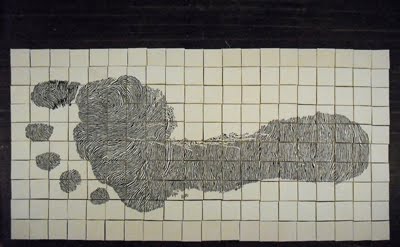
Nikki Rosato, Self-Portrait, detail. Photo: Nikki Rosato
Not only are our fingerprints, wrinkles and scars a representation of our identity, but our memories, the places we’ve been to, the people we’ve known have all changed and altered the path of who we become.

Nikki Rosato, Two Bostons, 16” X 16” X 14”, Cut map,
Armature wire, 2009. Photo: Nikki Rosato

Nikki Rosato, Two Bostons, Details. Photo: Nikki Rosato
Over the past few years I’ve been working on a large series where I’ve used road maps as a material in and of itself.

Nikki Rosato, Untitled, Installation View: Dimensions Variable, Cut map,
Spotlights, 2010. Photo: Nikki Rosato
With this series, I was thinking about how line alone can represent the human figure and how a memory of a place can have a direct impact on one’s identity. I saw a narrative within the details of the physical body—our bodies act as a record of our past.

Nikki Rosato, Untitled (Connections), 9” X 5.5”, Cut Map, 2010.
Photo: Nikki Rosato

Nikki Rosato, Untitled (Connections), 10” X 8”, Cut Map, 2010.
Photo: Nikki Rosato
In the Cut Map series, I dissected road maps for their lines with an x-acto knife, and through the process I created a portrait of a specific individual out of a specific place.

Nikki Rosato, Danny: Mt. Pleasant, MI, 10” X 8”, Cut Map, 2009.
Photo: Nikki Rosato

Nikki Rosato, Owen: Providence, RI, 9” X 8”, Cut Map, 2009.
Photo: Nikki Rosato
As I removed the landmasses from the silhouetted figure I further removed the person’s identity. Through the process of cutting, specific individuals become ambiguous and hauntingly ghost-like, similar to the memories they represent.

Nikki Rosato, Couple: Boston, MA, 11” X 14”, Cut Map, 2009.
Photo: Nikki Rosato

Nikki Rosato, Untitled (Connections), 14” X 11”, Cut Map, 2010.
Photo: Nikki Rosato

Nikki Rosato, Untitled (Self-Portrait), 20” X 16”, Cut Map, 2010.
Photo: Nikki Rosato

Nikki Rosato, Untitled (Connections), 8” X 12”, Cut Map, 2012.
Photo: Nikki Rosato
In my most recent work I’ve found inspiration from some of my own childhood photographs. Through mapping, drawing and painting I am working on unpacking and exploring my own memories of my personal past.

Nikki Rosato, Untitled (Childhood Portrait), 47” X 27”, Cut Map, 2011.
Photo: Nikki Rosato

Childhood Photographs. Photo: Nikki Rosato
Would you like to share a bit your creative process with our readers? How does it all start, what techniques and materials do you use?
The tedious process of making drives all the work that I create. As much as I have tried, I just cannot get myself to use a sketchbook. I insist on diving right into my “experiments,” and I treat them like final products. I find that I learn much more through the process of creating than through planning. Some of my greatest and largest “mistakes” have lead to break-through ideas.

Map scraps. Photo: Nikki Rosato

Vintage Maps. Photo: Nikki Rosato
Regardless of the project, my process must always be tedious and time-consuming—I cannot work any other way. I have endless amounts of anxious energy, which I release through sitting down and making. Whether the piece is a complex graphite rendering, or a large-scale cut paper piece, the final product just doesn’t feel right unless it takes endless hours to create.
I also think that setting up your work space with a blank sheet of paper and all the materials you need is important, for it leaves no excuse for procrastination.

Nikki Rosato: I always keep my favorite artists nearby.
Photo: Nikki Rosato
Do you have plans for your direction?
I am still working out my “next step” as my MFA thesis exhibition is quickly approaching. I am most excited about my most recent work, which is influenced by my Cut Map series, but is starting to move the idea into a new direction. It is important to always push yourself and move your work forward, even if it makes you uncomfortable.

Nikki Rosato, Altered Memory, 62” X 48”, Graphite, cut paper, 2011.
Photo: Nikki Rosato

Nikki Rosato, Altered Memory, Detail. Photo: Nikki Rosato

Nikki Rosato, Untitled (Childhood Portrait), 44” X 30.25”, Watercolor
on paper, 2011. Photo: Nikki Rosato

Nikki Rosato, Disintegration (Childhood Memory), 22” X 15”, Watercolor
on paper, 2011. Photo: Nikki Rosato

Nikki Rosato, Disintegration (Childhood Memory), 15” X 22”, Watercolor
on paper, 2011. Photo: Nikki Rosato
What is the most interesting comment about your work you have heard from a viewer?
Once you show your work to the public, you really do lose control over it. Everyone is bringing their own personal baggage to the piece and will have their own read that is influenced by their own past. For me, some of the most exciting comments are from viewers who are carrying the same baggage as myself, which causes the work to spark a conversation about a shared experience. Sharing a similar life experience with a viewer truly creates a sense of community.

Nikki Rosato, Untitled (Connections), 9.5” X 5.5”, Cut Map, 2010.
Photo: Nikki Rosato
For example, the work in my Connections series was inspired by a personal long distance relationship, and I’ve had multiple people come to me and tell me that they know what the work feels like, and that one of my Connections pieces has given them hope for the long distance relationship that they are currently in themselves.
How have you handled the commercial and business side of being an artist during this financial climate?
I find the business side of art to be just as important and time consuming as the making. There are so many facets to the art world and multitudes of ways to market yourself and your work. Even if people are not purchasing as much art due to the current economic climate, it is still important to get your work out there into the public and to build relationships with other artists and artistic spaces. Building your own artistic community and network does not have to necessarily come by monetary means.
Have you been actively involved in the Boston area art community? If yes, could you tell us about your involvements? Did you find the support you are looking for in the community?
I’ve only lived in Boston for about a year and half, and I’ve really enjoyed exploring the artistic opportunities that this city has to offer. Being connected to a place like School of the Museum of Fine Arts opens up a lot of doors for young and emerging artists in regards to exhibition opportunities as well as exposure to contemporary artists. The large academic community in Boston brings in visiting artists from all over the world, and every week there is a free lecture going on somewhere!
Have you participated in any art residencies in the past? If so, did the residency opportunity provide the support your needed for your personal growth and professional development ?
When I was living in Pittsburgh, I was involved in a year-long artist residency called The Distillery program. This program allowed you to work alongside a supportive group of artist peers. We met together weekly, worked together, bounced ideas off of each other, exhibited together. It is an incredible gift to have a community of your peers to talk through ideas with and to help you develop your work.

NikkiRosato, Turn Me On, Installation View: Dimensions Variable, Fabric,
beeswax, LED light, 2010. Photo: Don Orkoskey
Please share with us the grants/awards and recognition you received in the recent years. How important are awards for your art career? Do they bring opportunities?
While pursuing my undergraduate degree I received an Office of Experiential Learning Small Grant in order to travel to a printmaking conference. It was at the conference that I stumbled across the vintage road maps that sparked the whole Cut Map series—so you never know where and when inspiration may strike. Take advantage of every opportunity you receive!

Award-winning piece by Nikki Rosato, Self-Portrait, 10” X 27 ¾”,
Etching, 2007. Photo: Nikki Rosato
This piece, Self-Portrait, won an A.J. Schneider Award during my undergraduate senior exhibition. It is really an honor to receive such recognition for my work.
Would you like to inform our readers of your current and upcoming exhibits?
My work is currently on view at The Leonardo museum in Salt Lake City, Utah as part of an exhibition called There, there.
Are you available for commissioned works? Do you have website(s) about your work?
I love working on personal commissions for people—don’t hesitate to be in touch with me if you’d like a cut map portrait of yourself! Check out more of my work at www.NikkiRosato.com.

Nikki Rosato in front of her installation Untitled.
Would you provide links to articles about your work for interested readers to learn more about your work?
You can read more about my work in the following interview by Wired magazine:
http://www.wired.com/underwire/2011/05/nikki-rosato-map-portraits/
You can also see more of my work on ONY Architecture’s website:
http://www.onyarchitecture.com/#mi=2&pt=1&pi=10000&s=0&p=18&a=0&at=0
...............................................................................................


